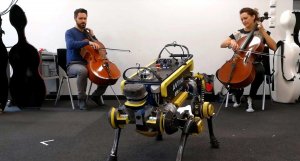
ZURICH — A four-legged machine at ETH Zurich's Department of Mechanical and Process Engineering has learned to move to the music, and it doesn't need a pre-programmed routine. The robot, named ANYmal, can listen to a track, determine its tempo, and generate its own dance steps on the fly, according to the research team behind the project.
The system works by analyzing the beats per minute (BPM) of any given song, then devising movements that match that speed. A built-in verification step ensures the robot's motion stays synchronized with the music. When the playlist switches to a different song, ANYmal adjusts its routine accordingly — though most of its repertoire consists of rhythmic shaking of its robotic hindquarters.
Péter Fankhauser, a doctoral student involved in the project, explained the motivation to The Verge: “We wanted to have it so if you bring the robot to a disco, it can figure out the music, create a choreography, and sync up its motion.” He added that the team is also interested in creating lifelike movements, noting that dancing is a very human and motion-intensive activity that is challenging to mimic.
While the disco demo may seem like pure novelty, the underlying technology has more serious implications. ANYmal's ability to create and execute its own movement plans in response to external stimuli is a form of feedback loop. Fankhauser compared this to a human's ability to imagine how they will complete a task before doing it. In the field, such capability could be applied to surveying or search-and-rescue operations, where a robot might need to adapt its movements to unpredictable terrain or changing conditions.
From Fun to Function
The dance project is part of a broader effort at ETH Zurich to push the boundaries of legged robotics. While much of the work is serious, this particular endeavor is meant to be enjoyable. “We do a lot of serious things with the robot, but this is the fun side,” Fankhauser said. “For us, for students, for everybody involved, it's enjoyable to do these things, and really explore the capabilities of the hardware.”
Other robots have demonstrated dancing abilities before, including the humanoid NAO robots and the so-called “stripper robots” shown at the Consumer Electronics Show. But those systems typically rely on pre-programmed sequences. ANYmal's distinction is its real-time reaction to the music, which allows it to improvise rather than repeat a fixed routine.
The research team has not announced any immediate plans to commercialize the dancing feature. Instead, the project serves as a demonstration of the robot's adaptability and control systems. As Fankhauser noted, the ability to generate and execute motion plans on the fly could one day help robots save lives in hazardous environments.